
THE BURNING RIM · MEDITERRANEAN
THE
MEDITERRANEAN
HOTSPOT
A region where sea warming, atmospheric instability and water stress are reshaping the climate system faster than expected.
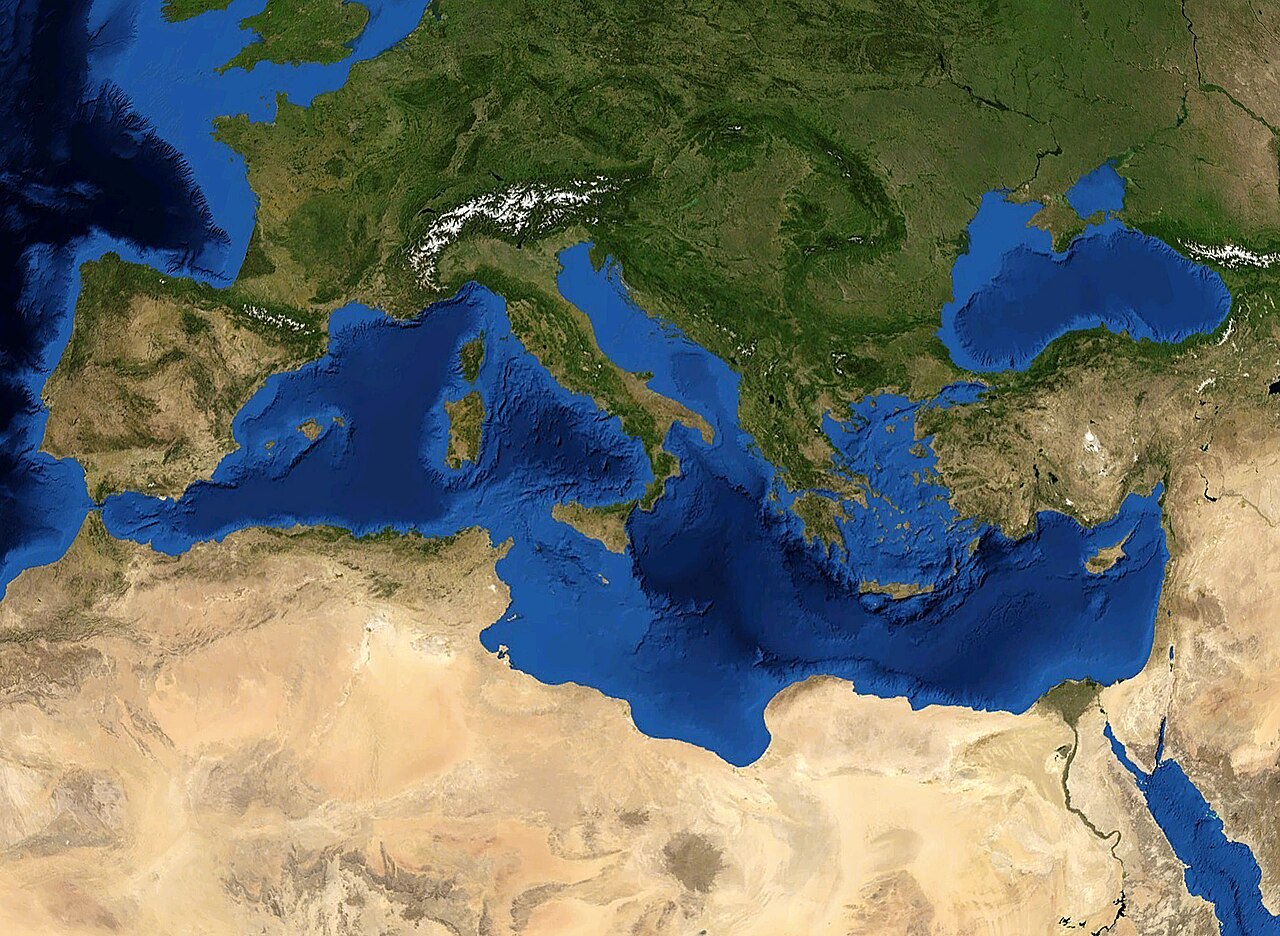
The Mediterranean basin is considered one of the most vulnerable climate hotspots on Earth.
Its geographical position, semi-enclosed structure and atmospheric circulation patterns make
it particularly sensitive to global climate change.
Over the last decades, scientific observations have revealed a persistent increase in sea surface
temperatures across large portions of the Mediterranean Sea. This warming trend is not only a
consequence of global temperature rise, but also the result of regional feedback mechanisms that
amplify heat accumulation inside the basin.
The Mediterranean behaves like a giant energy reservoir. During long and intense summer seasons,
the sea absorbs enormous amounts of solar radiation and stores heat for extended periods.
This excess energy does not remain confined to the water: it is progressively transferred to the
atmosphere through evaporation, humidity transport and turbulent exchanges.
As sea temperatures rise, the atmosphere above the basin becomes increasingly energetic and unstable.
Warmer waters favor stronger evaporation rates, injecting moisture into the lower troposphere and
providing fuel for convective systems and intense weather events.
The interaction between warm sea surfaces and atmospheric circulation can contribute to the
development of heavy rainfall events, severe thunderstorms and Mediterranean cyclones,
sometimes referred to as “medicanes”.
At the same time, climate projections indicate a progressive reduction in average precipitation,
particularly during winter seasons. This apparent contradiction — more intense storms but less
overall rainfall — is one of the characteristic signals of climate change in the Mediterranean region.
Drought conditions are becoming more frequent and prolonged, affecting agriculture, ecosystems,
freshwater availability and human activities. Water stress is expected to increase in many coastal
and inland regions during the coming decades.
The Mediterranean is therefore not only a passive victim of climate change, but an active component
of the climate system itself. Sea warming modifies atmospheric dynamics, which in turn influence
circulation patterns, precipitation regimes and regional climate behavior.
Understanding these interactions is essential to interpret the future evolution of the basin.
The Mediterranean represents a small-scale laboratory where global climate processes become visible
with particular intensity and speed.
SEA WARMING
Sea surface temperatures have increased significantly over recent decades, turning the basin into a major heat reservoir.
ATMOSPHERIC INSTABILITY
Warmer waters provide more moisture and energy to the atmosphere, supporting stronger convective activity and extreme events.
WATER STRESS
Reduced precipitation and prolonged drought periods increase pressure on ecosystems, agriculture and freshwater resources.
THE MEDITERRANEAN AS A CLIMATE LABORATORY
Because of its unique geographical and climatic characteristics, the Mediterranean basin offers
a clear representation of how regional systems respond to global climate forcing.
Rising temperatures, sea warming, changing precipitation patterns and atmospheric instability
are not isolated phenomena. They are interconnected components of a complex system where
ocean and atmosphere continuously exchange energy.
The Burning Rim explores these relationships through data, scientific interpretation and visual storytelling,
transforming the Mediterranean into a readable map of climate transformation.