THE BURNING RIM · ATMOSPHERE
THE
ATMOSPHERE
IN TRANSITION
A dynamic system where temperature, circulation and vertical exchanges are being altered by climate change.
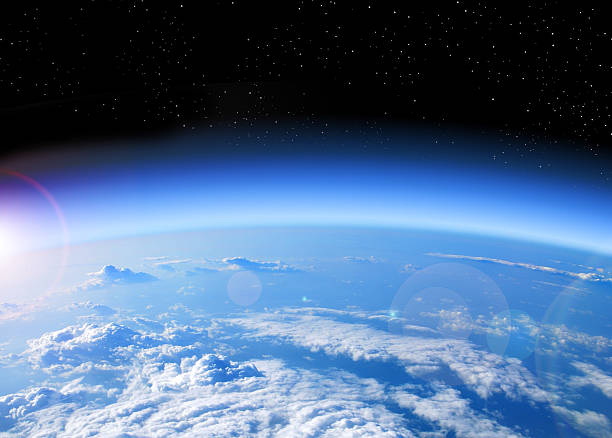
The atmosphere is not a static structure. It is a continuously evolving system where energy,
humidity, gases and particles move across different layers through complex physical processes.
Climate change is modifying this balance. Scientific observations collected over recent decades
reveal significant transformations in atmospheric temperature distribution, circulation patterns
and vertical exchanges between the troposphere and the stratosphere.
The troposphere, the lowest atmospheric layer where weather develops, is warming progressively
due to increasing greenhouse gas concentrations. At the same time, the stratosphere above it
is cooling — a characteristic fingerprint of anthropogenic climate change.
Between these two layers lies the tropopause, a transition region that acts as a dynamic boundary
regulating exchanges of air masses, humidity, ozone and chemical compounds.
The tropopause is not a fixed surface. Its altitude changes depending on latitude, season,
atmospheric circulation and wave activity. Climate change appears to influence its structure,
contributing to a gradual rise in tropopause height observed in several regions of the world.
One of the most important mechanisms affecting upper atmospheric dynamics is the interaction
between jet streams, Rossby waves and large-scale circulation systems. These structures control
the transport of heat and momentum across the atmosphere and strongly influence weather evolution.
Variations in jet stream intensity and position may alter the persistence of high-pressure systems,
storm tracks and precipitation patterns. In the Mediterranean region, these changes can amplify
periods of drought, heatwaves and atmospheric instability.
Another important process is Stratosphere–Troposphere Exchange (STE), through which air masses
move vertically between atmospheric layers. STE events can transport ozone-rich stratospheric air
downward into the troposphere, affecting atmospheric chemistry and radiative balance.
Atmospheric instability is closely linked to energy distribution. A warmer atmosphere can hold
more water vapor, increasing the amount of latent heat available for convective systems.
This creates conditions favorable for more intense precipitation events and stronger storms.
Understanding the atmosphere means understanding a system where local and global processes are
deeply connected. What happens above the Mediterranean is influenced by planetary circulation,
ocean temperatures and long-term climate forcing.
TROPOSPHERE
The lower atmosphere is warming and storing more humidity and energy, influencing weather intensity and variability.
TROPOPAUSE
The transition zone between troposphere and stratosphere regulates vertical atmospheric exchanges and circulation dynamics.
JET STREAMS
Large-scale atmospheric currents influence storm evolution, heat transport and regional climate behavior.
READING THE SKY TO UNDERSTAND CLIMATE
Atmospheric layers are interconnected components of a global climate engine where temperature,
circulation and chemistry constantly interact.
Climate change modifies these interactions at multiple scales, from local convection to planetary circulation.
The atmosphere therefore becomes both a signal and a driver of climate transformation.
The Burning Rim explores these processes through scientific interpretation, atmospheric dynamics
and visual storytelling, connecting upper atmospheric physics with the future of the Mediterranean basin.